
 English
 العربية
A marble table is not furniture you buy off a shelf in one fixed size — it is a stone slab that is cut, polished and mounted on a base strong enough to carry it. This guide walks you through choosing the stone, the size, the edge profile and the base, what actually drives the price, and how to order a custom marble table in Riyadh or anywhere in Saudi Arabia without surprises.
In this guide
Why marble?
Marble is a natural stone formed over millions of years, which is why no two slabs carry the same veining. That fingerprint is the first reason people choose it for tables: the piece in the centre of a majlis or living room becomes a visual object in its own right, not just a surface.
The second reason is practical. Marble is cool to the touch, heavy and dimensionally stable — it does not flex or sag over the years the way some engineered surfaces do, and it lasts decades with simple care. The third is value: one marble table changes the perception of a room more than replacing all the furniture in it.
Marble is not always the answer. For surfaces exposed to acids every day — open kitchens, drinks tables — granite or engineered stone may serve you better. Section seven explains the trade-offs.
Types of marble tables by use
Coffee table
The most requested piece in Saudi majlis interiors. Usually round or oval, low, and able to carry a bold stone because it is the focal point.
Centre table
Larger and heavier, sized to the surrounding seating. Calmer veining works better here so it does not fight the upholstery.
Dining table
The hardest working piece. Needs greater thickness, a central or twin base, and a properly sealed surface.
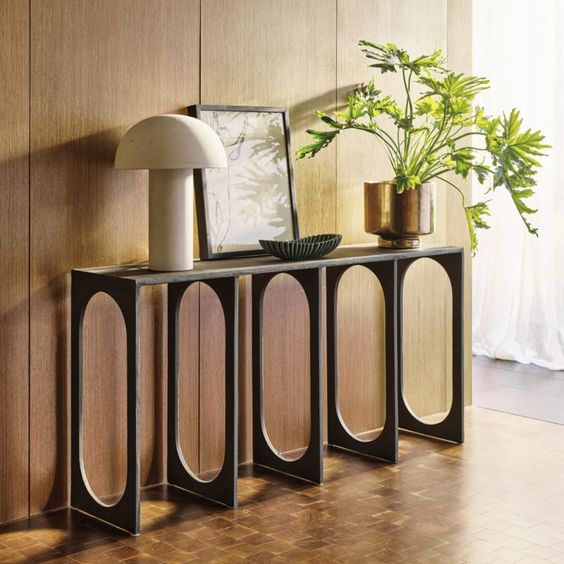
Console table
Long and narrow, for entrances and corridors. Works beautifully with carved edges and darker stones.
Side table
Small pieces beside a sofa or bed — an excellent way to use offcuts of premium slabs at a lower cost.
Office and reception tops
For commercial projects. Needs careful load and fixing calculations, and often non-standard slab sizes.

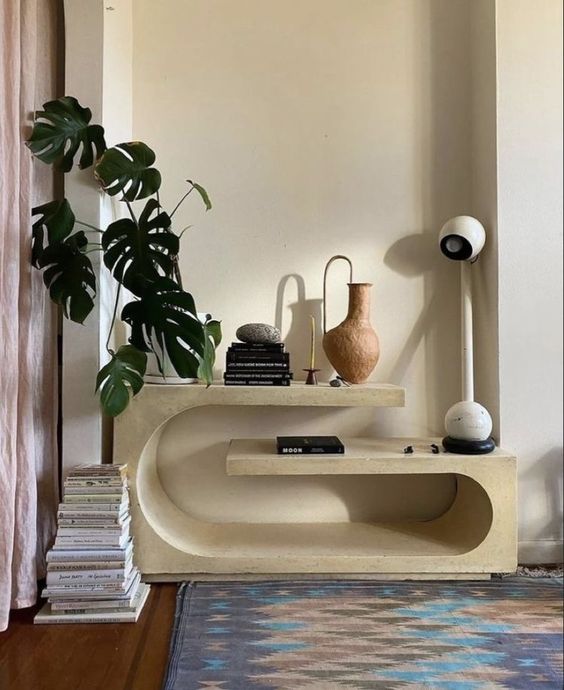
Best stones for marble tables
Choose the stone type before the colour. This is the comparison we run through with clients:
| Stone | Look | Best for | Notes |
|---|---|---|---|
| Carrara marble | White-grey with soft veining | Coffee tables, consoles | Classic and widely available; calm veining suits any interior |
| Calacatta marble | Bright white with bold gold/grey veins | Statement pieces | More premium; every slab is genuinely different |
| Nero Marquina | Black with sharp white veins | Consoles and entrances | Shows fingerprints — a honed finish is recommended |
| Travertine | Warm beige with natural pores | Earthy, organic interiors | Needs pore filling before polishing |
| Onyx | Translucent with dramatic veining | Backlit, sculptural pieces | Relatively fragile; needs backing support and careful fabrication |
| Granite | Fine grain, wide colour range | Everyday dining tables | Harder and far less reactive to acids than marble |
| Engineered stone | Consistent colour and pattern | Fixed budgets, large formats | Less porous and easier to maintain, but without unique natural veining |
Browse what is actually in stock in Marble Slabs and Artificial Stone, or see our stone table tops.
Standard marble table sizes
Size is not only taste — it is the relationship between the table and the space around it. The working rule: leave at least 40 cm between the table edge and the seating, and 75–90 cm of circulation around a dining table.
| Type | Common size | Height | Suggested thickness |
|---|---|---|---|
| Round coffee table | 60–90 cm diameter | 40–45 cm | 20 mm |
| Rectangular centre table | 120×60 to 140×70 cm | 40–45 cm | 20–30 mm |
| Dining table, 6 seats | 180×90 cm | 75 cm | 30 mm |
| Dining table, 8–10 seats | 240×100 cm | 75 cm | 30 mm or more |
| Entrance console | 120–180 × 35–45 cm | 75–85 cm | 20 mm |
| Side table | 40–50 cm diameter | 55–60 cm | 20 mm |
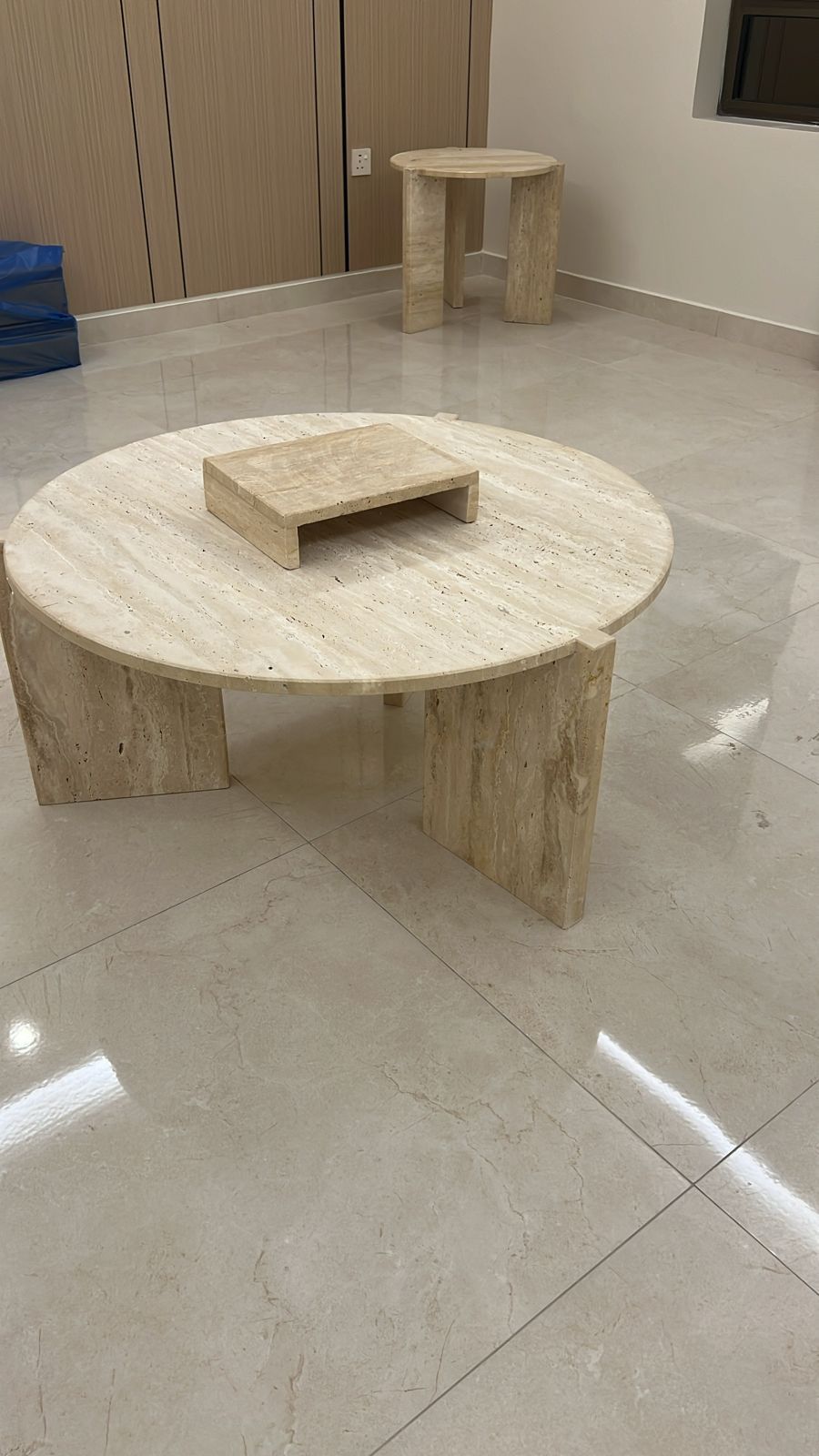
Thickness and edge profiles
Slabs are commonly 20 mm or 30 mm. Twenty is lighter and less expensive and is fine for small and medium tables; thirty is stronger and reads as more substantial, and it is the right call for dining tables and anything beyond 160 cm.
If you want the look of a thick slab at a lower cost, ask for a mitred edge: a strip cut from the same slab is bonded under the edge at 45 degrees, so a 20 mm top reads as 40–60 mm.
Flat edge
The most contemporary and the least expensive. Suits modern and minimal interiors.
Bullnose
Soft and safer around children, and it hides minor edge wear well.
Bevel
A simple chamfer that signals precise fabrication without being decorative.
Ogee
Classic and rich. Takes longer on the machine and adds to the cost.
The base: wood, metal or stone?
The most common execution error is not in the slab — it is in the base. A 120×60 cm marble top at 20 mm weighs roughly 40 kg, and a 240 cm dining top can exceed 150 kg. The base must be engineered for that weight, not only for its looks.
- Steel base (stainless or coated): the strongest and visually the slimmest, and it spans large tops without a centre support. Our default recommendation for dining tables.
- Wooden base: warm and suited to classic interiors, but it needs greater section sizes and precise fixing to avoid movement over time.
- Stone base: the most luxurious — the table reads as a single block. Heaviest and most expensive, and it needs a floor that can take the point loads.
Marble is never screwed down directly. We use flexible structural silicone with support pads so the stone can move thermally without cracking. If a workshop proposes drilling straight through a thin top, walk away.
What actually drives the price
There is no single “price of a marble table”, because the cost is built from six independent components. Understanding them lets you compare quotes intelligently instead of comparing one final number:
| Component | Effect on price | How to save without losing quality |
|---|---|---|
| Stone type | The largest factor — Calacatta can be several times Carrara | Pick a common stone with a similar tone |
| Size | Jumps once you exceed a standard slab | Design within slab limits to avoid seams |
| Thickness | 30 mm is meaningfully higher than 20 mm | 20 mm with a mitred edge gives the same look |
| Edge profile | Carved profiles add machine hours | Flat or bevelled is cheaper and more current |
| Base | Custom steel is a line item of its own | Use a ready base sized to the top |
| Finishing and installation | Polishing, sealing, packing and delivery | Combine several pieces into one installation visit |
The custom order process
- Define the use and the space. A photo plus the available dimensions settles half the conversation.
- Select the actual slab. Because every slab is unique, we send photos of what is physically in stock so you choose the veining you want.
- Approve the drawing. Final size, thickness, edge profile and base type — written and approved before any cutting.
- CNC cutting and shaping. This is what guarantees dimensional accuracy, especially on round and oval tops.
- Polishing and sealing. Polished or honed finish, then an impregnating sealer against staining.
- Packing and transport. Slabs travel upright, never flat — wrong transport causes most breakages.
- Installation and handover. Levelling the base, bedding the top, final clean.
Caring for a marble table
- Wipe spills immediately — lemon, vinegar, coffee and wine etch natural marble and leave a dull mark.
- Use a pH-neutral soap and lukewarm water. Avoid acidic or bleach-based cleaners.
- Re-seal every 6–12 months on heavily used surfaces.
- Use coasters and trivets — not because of heat, but because of rings and scratches.
- Lift, do not drag. Scratches show easily on a polished finish under raking light.
Five common mistakes when buying a marble table
- Choosing the colour from a phone photo. Lighting changes the stone completely — ask for a photo of the real slab, and view it if you can.
- Ignoring the weight. Upper floors and timber floors need the load and the access route checked.
- Ordering a size without measuring the room. The right table in the wrong space ruins both.
- Not asking about seams. If the size exceeds the slab, there will be a joint — ask where it falls and how it will be hidden.
- Comparing prices without comparing the specification. A cheaper 20 mm flat-edge quote is not actually cheaper than a 30 mm ogee-edge one.
Frequently asked questions
How much does a marble table cost in Saudi Arabia?
There is no fixed price: the cost is built from the stone type, size, thickness, edge profile, base and installation. Send us the size and intended use and you will have a final figure within minutes on WhatsApp or by email.
Does marble stain easily?
Natural marble is porous, so table tops are treated with an impregnating sealer that stops liquids soaking in. With immediate wiping and annual re-sealing, the table stays clean for many years.
Marble or granite for a dining table?
For heavy daily use with children, granite is harder and far less reactive to acids. If the veining and the look are the priority, nothing matches marble. Many clients choose marble for the majlis and granite for the dining table.
Can you make a non-standard size?
Yes — every table is made to order: size, shape (round, oval, rectangular, organic), edge profile and base. The only limit is the maximum slab size before a seam becomes necessary.
How long does fabrication take?
It depends on stone availability and the complexity of the shape. Slabs in our warehouse are usually a few days; imported stone or special shapes take longer. We confirm the lead time with the quote, not after it.
Do you deliver and install outside Riyadh?
Yes. We supply and install in Riyadh, Jeddah, Dammam, Khobar, Makkah, Madinah, Qassim and the rest of the Kingdom, with packing designed for safe transport.
FREE QUOTE
Order a marble table made to your size
Send us the dimensions and the intended use, and the KAASEB team comes back with a clear quote covering stone, base and installation — within minutes.
Prefer WhatsApp? Message us on +966 50 626 8080
