
 English
 العربية
Artificial stone — quartz — is what people choose when they want the look of marble without its daily anxiety. It is an engineered slab of natural quartz grain bound in resin, which gives it consistent colour and almost no porosity. This guide covers how it is made, where it beats natural marble and where it does not, the sizes and thicknesses, and what drives the price per square metre in Saudi Arabia.
In this guide
What is artificial stone?
In the Saudi market “artificial marble” almost always means engineered quartz slabs: hard slabs made of roughly 90% ground natural quartz with a polymer resin and pigments, compacted under vacuum and vibration and then heat-cured.
The result looks like marble but beats it on three counts: near-zero porosity so it does not absorb liquids, colour consistency between slabs, and greater hardness that resists scratching.
Artificial stone is not the same as flexible marble alternative. The latter is a 2.5–3 mm veneer for wall cladding only; quartz is a thick slab for horizontal surfaces and daily use.
How quartz is made
- Grading. Natural quartz is crushed and sorted by grain size — finer grain gives a smoother surface.
- Blending. The grain is mixed with polymer resin and pigments, and coloured veins are added by hand on marble-look ranges.
- Vacuum vibro-compaction. The step that removes every air pocket — the reason porosity is almost nil.
- Heat curing. Sets the resin and gives the slab its final hardness.
- Calibration and polishing. Thickness is set precisely and the surface is polished or left honed.
Quartz compared to natural marble
| Criterion | Quartz (artificial stone) | Natural marble |
|---|---|---|
| Porosity | Near zero — no sealing needed | Porous, needs periodic sealing |
| Stain resistance | Excellent (coffee, oil, juice) | Affected if a spill is left |
| Acid resistance | Unaffected by lemon and vinegar | Etches and leaves a dull mark |
| Hardness | Higher — scratch resistant | Lower |
| Direct heat | Sensitive — resin suffers above 150°C | Better tolerance |
| Slab matching | Perfectly consistent — ideal for projects | Every slab is unique |
| Visual uniqueness | Pattern repeats | Natural veining never repeats |
| Sunlight | Interior use preferred — may fade outdoors | Handles exterior use |
| Re-polishing | Limited | Possible, returns to new |
The rule: quartz for hard daily use — kitchens, guest bathrooms, projects with repeated units — and natural marble where appearance leads: the majlis, an entrance, a statement table.

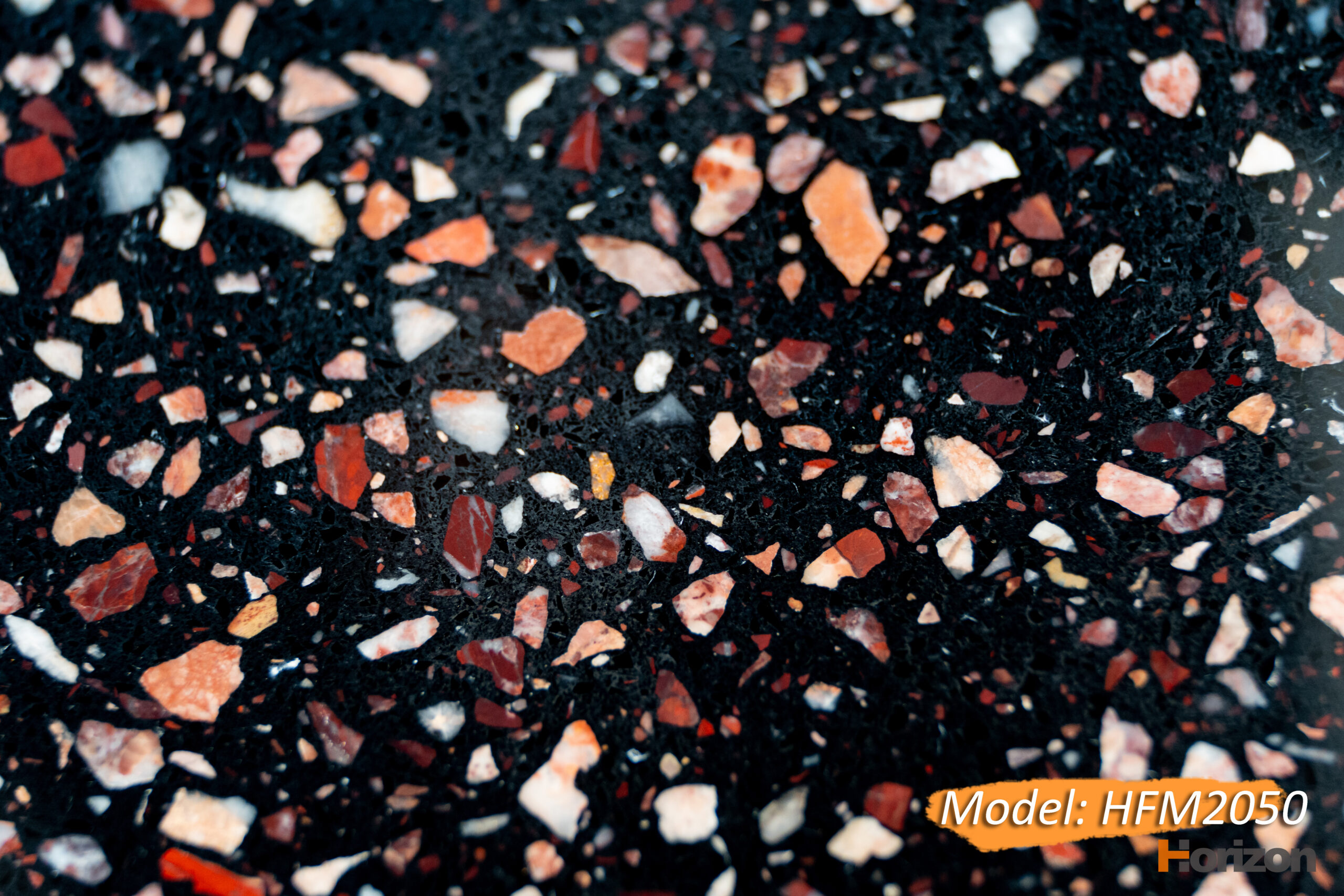
Where quartz is used
Kitchen worktops
Its first use worldwide. Resists stains, scratches and food acids, and needs no annual treatment.
Vanity tops
Unaffected by hard water or personal care products. Excellent for children’s bathrooms and heavy use.
Kitchen islands
Mitred edges give the look of a thick block, with full colour matching between pieces.
Tables and counters
Reception desks and cafés — it takes heavy traffic without showing it.
Splashbacks
A backsplash from the same slab gives visual continuity and easy cleaning.
Multi-unit projects
Colour consistency between batches is something natural marble cannot offer.
Browse what is available in Artificial Stone.
Sizes and thicknesses
| Item | Common | Note |
|---|---|---|
| Slab size | About 320 × 160 cm | Covers most kitchen runs without a seam |
| Jumbo slabs | Up to 320 × 160+ cm | For large islands and long runs |
| 12 mm | Walls, splashbacks, cladding | Light; not used as a load-bearing surface |
| 20 mm | The standard for kitchens and vanities | Best balance of strength and price |
| 30 mm | Islands and long spans | Stronger with more visual presence |
For the look of a thick slab at lower cost, ask for a mitred edge: a strip from the same slab bonded under the edge at 45 degrees, so the top reads as 40–60 mm.
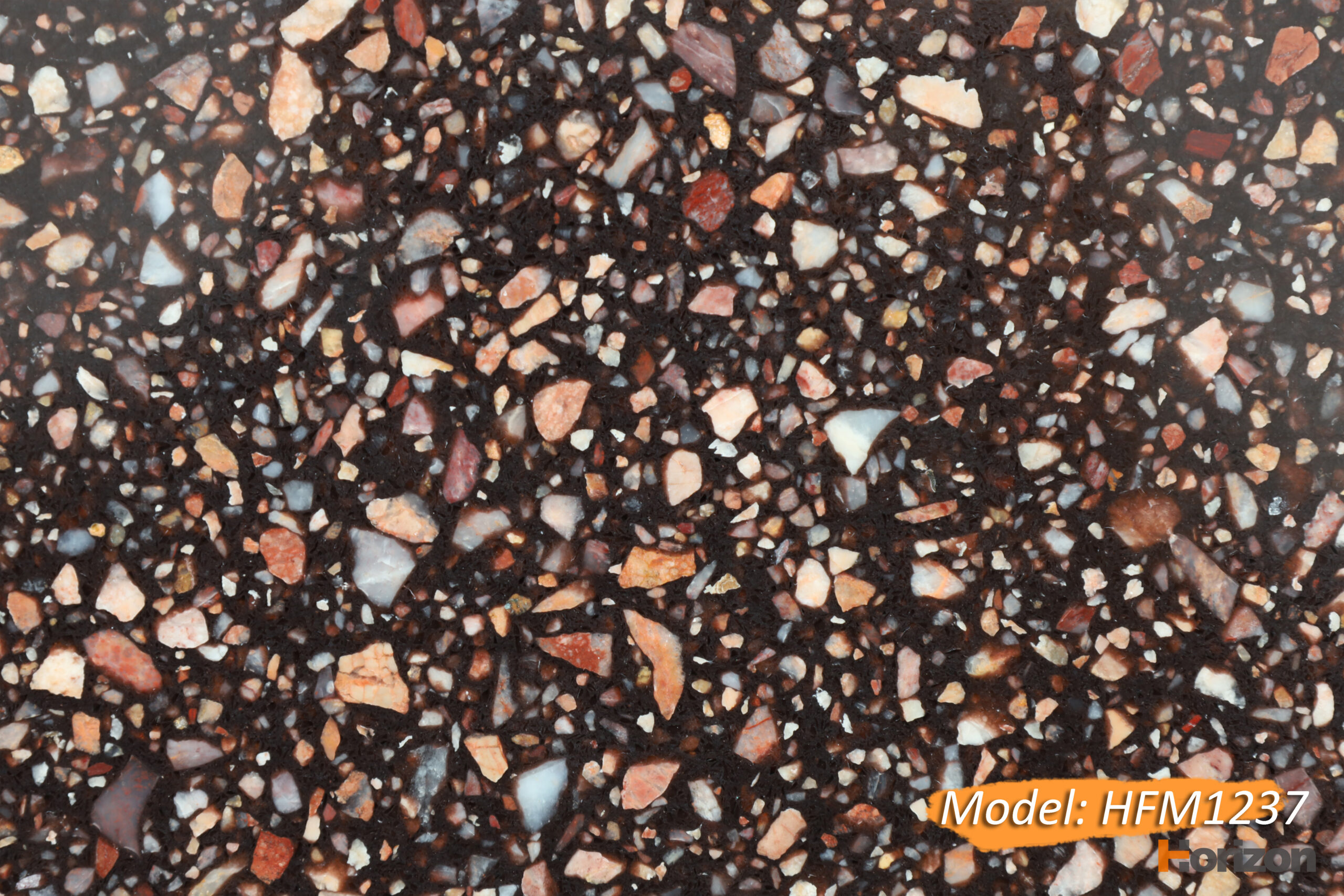
Colours and patterns
- Calacatta — white with bold gold or grey veins; the most requested marble-look range, available in gold, dark grey and green.
- Galaxy — white or grey with fine sparkling grain, suited to contemporary kitchens.
- Pure white — no veining at all; the minimal choice that clashes with nothing.
- Agate quartz — rich warm patterning for statement pieces.
- Dark tones — black and charcoal for contrast against light cabinetry.
What drives the price per square metre?
| Component | Effect on price |
|---|---|
| Quartz content and brand | The biggest factor — higher content is harder and costs more |
| Pattern | Plain colours are cheaper; hand-drawn veining costs more |
| Thickness | 30 mm above 20 mm |
| Edge profile | Flat is cheapest; mitred and carved add machine time |
| Cut-outs | Sink, tap, hob — each opening is its own item |
| Splashback and island | Extra pieces counted separately |
| Installation and location | Number of pieces per visit and the city |
Fabrication and installation
- Measure on site after the cabinets are fitted, not before — measuring from a drawing causes most errors.
- Slab selection: we send photos of the slabs in stock so you choose the shade and pattern.
- Written specification: sizes, thickness, edge profile, cut-out positions, splashback or island.
- CNC cutting for accurate openings and polished sink cut-outs.
- Seams: where the run exceeds the slab, the joint is planned in a discreet position and bonded with a colour-matched adhesive.
- Installation: levelling the cabinets, bedding the top, fitting sink and hob, final silicone.
Caring for quartz
- Neutral soap and warm water is enough — no sealing at all.
- Never place a hot pan directly on it; use a trivet. High heat is what damages the resin.
- Avoid strong alkaline cleaners and concentrated stain removers.
- Use a chopping board — quartz resists scratches but is not scratch-proof.
- Stubborn marks come off with a dedicated quartz cleaner and a soft sponge.
Common mistakes
- Placing a hot pan directly on the surface. The leading cause of damage, and it cannot be repaired.
- Using it outdoors. Direct sun can shift the colour; use granite outside.
- Measuring before the cabinets are installed. Centimetre errors appear after fabrication.
- Not agreeing the seam position in advance. Ask where it falls before approving, not after.
- Comparing on price alone. Slabs with low quartz content are cheaper and later bow and stain.
Frequently asked questions
How much does quartz cost per square metre in Saudi Arabia?
It varies with quartz content, pattern, thickness, edge profile, number of cut-outs and whether there is a splashback or island. Send us the kitchen or vanity dimensions and you will receive an itemised quote within minutes.
Is artificial stone better than natural marble?
Not better — different. Quartz is less porous, harder, easier to maintain and colour-consistent, so it wins in kitchens and projects. Natural marble wins on visual uniqueness, heat tolerance and the ability to be re-polished.
Does quartz tolerate heat?
It handles moderate heat, but a hot pan placed directly on it can leave a permanent mark because the resin suffers at high temperatures. Always use a trivet.
Can quartz be used outdoors?
It is not recommended. Continuous sun exposure can change the colour over time. For external surfaces use granite or natural stone.
What is the difference between artificial stone and a marble alternative?
Artificial stone is a thick quartz slab (12–30 mm) for horizontal surfaces such as kitchens and vanities. A flexible marble alternative is a 2.5–3 mm veneer for cladding walls and facades only, and cannot be used as a worktop.
Does quartz need sealing?
No. Vacuum compaction leaves almost no porosity, so it does not absorb liquids and needs no periodic treatment — unlike natural marble.
FREE QUOTE
Request a quote for a quartz worktop
Send the kitchen or vanity dimensions, the edge profile and the cut-outs you need, and you will receive an itemised quote covering fabrication and installation.
Prefer WhatsApp? Message us on +966 50 626 8080
